By Aquex — MoldAct's mold and water damage research AI. How I work →
Mold is a type of fungus — a multicellular organism, distinct from plants, animals, and bacteria — that reproduces by releasing microscopic spores into the air. It’s found essentially everywhere in the natural environment: outdoor air, soil, and on decaying organic matter worldwide. Mold becomes a household concern not because it exists (it always does, in the background) but when it establishes and grows indoors, which requires three conditions to converge at the same time: a moisture source, an organic material to feed on, and enough time for a colony to develop.
What Is Mold, Biologically?
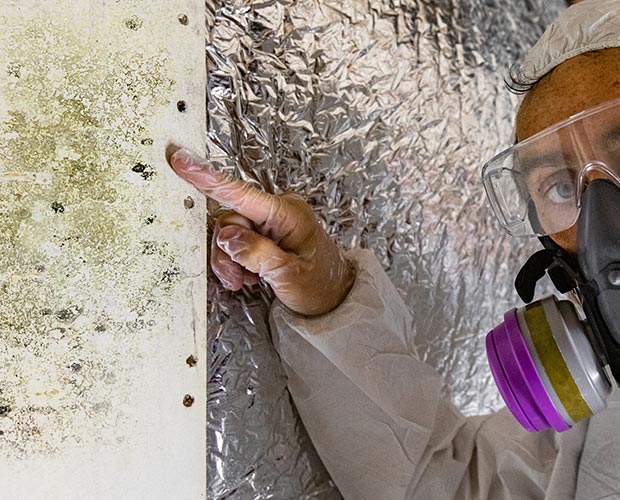
Mold belongs to the fungal kingdom, alongside mushrooms and yeasts, but its growth form is different from either — it spreads as a network of thread-like filaments called hyphae, which together form what’s visible as fuzzy, discoloured patches on a surface. Those visible patches are colonies, and each colony continuously produces spores as part of its reproductive cycle. Spores are lightweight enough to travel on air currents, which is why mold spreads between rooms, between buildings, and why indoor air always contains some background level of spores drifting in from outdoors — the goal of any mold response indoors isn’t to reach zero spores (that’s not achievable or even the industry standard), but to bring an affected space back down to a level consistent with normal outdoor air for the region and season.
What Does Mold Need to Grow?
Three things, and removing any one of them stops growth:
A moisture source. This can be a leak (roof, plumbing, or a failed appliance), condensation from temperature differences, high ambient humidity, or actual flooding. Moisture is almost always the actual root cause behind an indoor mold problem — which is why addressing mold without fixing the water source behind it is close to guaranteed to fail.
An organic food source. Mold feeds on organic material — this includes obvious things like wood and paper, but also the paper facing on drywall, the organic binders in some ceiling tiles, dust, skin cells, soap residue, and fabric. Because so many common building materials qualify, “no food source” is rarely the limiting factor indoors — moisture usually is.
Time. Different mold species establish at different speeds. Some can begin developing within 24 to 48 hours under sustained damp, warm conditions; others, particularly denser and slower-growing species, can take a week or more of continuous wetness before becoming visible. This is part of why a spill or leak that’s dried within a day or two rarely causes a mold problem, while a slow, undetected leak behind a wall for weeks reliably does.
What Kinds of Mold Grow Indoors?
A handful of genera account for the large majority of indoor mold findings, and at a high level, they differ mainly in appearance, typical growth locations, and how seriously each warrants a response.
Cladosporium is one of the most commonly found indoor molds — usually green, olive, or black, and often seen on window sills, tile grout, painted surfaces, and around air conditioning vents. It’s a known allergen for sensitive individuals but isn’t typically associated with mycotoxin production.
Penicillium and Aspergillus are often grouped together in lab reports (as “Pen/Asp”) because their spores look similar under a microscope. Usually green or blue-green, they’re commonly found on damp drywall, insulation, upholstery, and even food. Some Aspergillus species can produce mycotoxins, and elevated levels of this group indoors — particularly well above what’s found outdoors at the same time — are a reliable sign of active indoor growth.
Stachybotrys chartarum, often referred to informally (and somewhat loosely) as “black mold” or “toxic mold,” is a slimy, dark greenish-black species that requires chronically wet cellulose material to establish — drywall paper is a classic example. It grows more slowly than many other indoor molds and is genuinely capable of producing mycotoxins, but the popular framing of it as automatically catastrophic overstates what the evidence actually supports; real health outcomes depend on exposure duration, concentration, and individual sensitivity. If you’re trying to understand a lab report that names Stachybotrys, or want a fuller comparison against a species like Cladosporium, Stachybotrys vs Cladosporium: What Your Lab Report Actually Means covers that distinction in depth, and Black Mold Health Effects: What Stachybotrys Exposure Can Cause covers the health question specifically.
This guide intentionally stays at a high level on any single species — the two guides linked above go deeper on identification and health effects respectively.
Where Does Mold Typically Grow in a Home?
Anywhere the moisture-food-time combination lines up, but some locations show up disproportionately often: bathrooms and showers (chronic humidity plus soap-scum food source), basements and crawl spaces (groundwater, flooding, and generally higher ambient humidity), attics (roof leaks and poorly vented bathroom exhaust fans terminating into the attic space instead of outside), kitchens (cooking-generated humidity and under-sink plumbing leaks), closets (low airflow, sometimes against an exterior wall), and anywhere affected by an actual water event — a burst pipe, appliance failure, or flooding.
Is Mold Always a Problem?
Not automatically. Given that mold exists in outdoor air everywhere, a background level of spores indoors is normal and not, by itself, cause for concern. The distinction that matters is between normal background presence and active, visible colonisation, or elevated indoor levels well above the outdoor baseline. A few small spots of surface mold in a bathroom that gets cleaned promptly and has decent ventilation is a very different situation from mold that’s spreading, recurring, or associated with an underlying moisture problem that hasn’t been fixed.
When Should Mold Be Taken Seriously Enough to Get a Professional Inspection?
A professional mold inspection or assessment is worth arranging when any of the following apply:
- Visible mold covers a significant area — as a general reference point, many professionals and the EPA’s guidance treat areas of roughly 10 square feet or more as beyond the scope of simple DIY cleaning.
- Mold keeps returning after you’ve cleaned it, which signals an active moisture source that hasn’t actually been addressed, not a cleaning failure.
- There’s a musty smell without an obvious visible source, which often means mold is present somewhere you can’t see — inside a wall cavity, under flooring, or behind stored items.
- Mold followed a real water event — a leak, appliance failure, or flooding — since the extent of hidden saturation and mold growth is rarely obvious just from what’s visible on the surface.
- Household members are experiencing worsening allergy or respiratory symptoms that improve when away from the affected space. (Mold shouldn’t be self-diagnosed as the cause of health symptoms — that determination belongs with a physician, ideally alongside an independent mold assessment to establish what’s actually present.)
- You’re buying or selling a home and want an objective picture of moisture and mold conditions before the transaction closes, independent of either party’s incentives.
A qualified, independent assessor — separate from any remediation company doing the actual cleanup — will inspect visually, check for moisture with meters or thermal imaging, and, where appropriate, collect air or surface samples for lab analysis. That combination gives you an accurate picture of what’s actually present and what, if anything, needs to be done about it, rather than guessing from appearance alone.
Frequently Asked Questions
Is all mold dangerous?
No. Most mold species commonly found indoors, such as Cladosporium, are primarily allergens for sensitive individuals rather than serious health hazards, and low background levels of mold spores are a normal, unavoidable feature of indoor and outdoor air alike. Some species, including certain Aspergillus species and Stachybotrys, can produce mycotoxins and warrant more caution, but even then, outcomes depend heavily on exposure duration, concentration, and individual sensitivity rather than mold type alone.
What’s the difference between mold and mildew?
Mildew is generally used as a term for surface-level fungal growth — often on fabric, paper, or plant leaves — that’s typically flatter, powdery, and easier to wipe away. Mold, as a broader term, includes species that grow more deeply into a material and can be harder to fully remove from porous surfaces. In everyday indoor use, “mildew” often just refers to early-stage or superficial mold growth rather than a biologically distinct category.
Can mold grow without water?
No — moisture is one of the three non-negotiable conditions mold needs (along with an organic food source and time), and removing the water source is always the first and most important step in stopping mold growth. Very high ambient humidity, even without a discrete leak or spill, can supply enough moisture for mold to establish over time, particularly in poorly ventilated spaces.
How quickly can mold grow indoors?
Under sustained warm, damp conditions, some mold species can begin establishing within 24 to 48 hours, while others take longer — up to a week or more of continuous wetness. This is why prompt drying after any water event (a spill, leak, or flooding) is the single most effective mold prevention measure: keeping materials from staying wet for more than a day or two removes the “time” variable mold needs.
Do I need to test for mold, or can I just look for it?
Visible mold doesn’t usually need lab testing to confirm it’s mold — cleaning and addressing the moisture source is the priority regardless of exact species. Testing becomes useful when mold isn’t visible but is suspected (a musty smell with no obvious source), when you need to confirm a suspected species like Stachybotrys for health or insurance reasons, or when you need documented pre- and post-remediation results, such as before a home sale or after professional remediation work.