Mold testing in South Beach: what to know
South Beach's Art Deco buildings (1930s–1940s) were built to pre-air-conditioning standards with large windows and cross-ventilation design — modern HVAC retrofits in these buildings often introduce condensate overflow issues in wall cavities not designed for mechanical cooling.
The constant salt air from the Atlantic Ocean and Biscayne Bay accelerates building envelope degradation — window seal failures and exterior wall cracks admit moisture rapidly, creating mold in exterior-facing wall assemblies.
SoBe's very high tourism density and short-term rental activity means mold is often unreported until it reaches an advanced stage — occupants turn over before sustaining health effects, and building managers may not investigate musty odours promptly.
Mold conditions in South Beach
Common mold types in this area: Aspergillus/Penicillium (HVAC systems in Art Deco retrofits); Cladosporium (salt-air-accelerated exterior and interior growth); Stachybotrys (historic buildings with chronic slow leaks); Curvularia (tropical South Florida species).
We serve Ocean Drive, South Beach boardwalk, Lummus Park, Flamingo Park, Lincoln Road (nearby) and the wider South Beach area across ZIP codes 33139.
Signs you need mold testing
- Unexplained musty odour with no visible mold
- Health symptoms that improve when occupants leave the building
- Post-remediation verification that work was completed successfully
- Pre-purchase due diligence on a home or commercial property
- Landlord-tenant dispute requiring independent third-party documentation
- Insurance claim requiring laboratory evidence of mold type and extent
How we handle mold testing in South Beach
Mold testing is not the same as a mold inspection. Testing refers specifically to the collection and laboratory analysis of air or surface samples to identify mold species and quantify spore concentrations. An inspection includes testing but also includes a visual survey, moisture mapping, and a written remediation protocol. Testing alone — without the inspection context — can produce data that is difficult to interpret correctly.
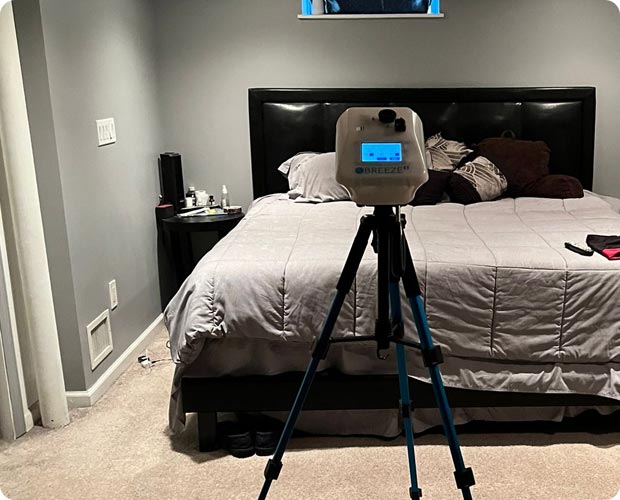
Air sampling for mold uses impaction cassettes (Air-O-Cell, Zefon BioPump) that capture particles from a calibrated air volume onto a collection medium. The cassette is analysed by a qualified analyst under microscopy. Results are reported as spores per cubic metre for each species identified. Critically, indoor samples must always be compared to an outdoor control sample taken simultaneously — outdoor spore counts vary by season, weather, and location.