Mold testing in Wynwood: what to know
Wynwood's industrial and warehouse buildings — many repurposed as art galleries, studios, and mixed-use spaces — have flat roofs and minimal insulation that create extreme attic and roof-deck heat and humidity, driving rapid mold growth after any roof membrane failure.
The neighbourhood's rapid gentrification has produced many renovation projects in buildings not remediated after historic flooding — mold discovered during demolition is common in older Wynwood industrial stock.
Mold conditions in Wynwood
Common mold types in this area: Aspergillus/Penicillium (flat-roof building interiors); Cladosporium (warehouse and studio interiors); Stachybotrys (unremediated historic flooding in older buildings).
We serve Wynwood Walls, Wynwood Garage, Wynwood Yard, NW 2nd Avenue arts district and the wider Wynwood area across ZIP codes 33127.
Signs you need mold testing
- Unexplained musty odour with no visible mold
- Health symptoms that improve when occupants leave the building
- Post-remediation verification that work was completed successfully
- Pre-purchase due diligence on a home or commercial property
- Landlord-tenant dispute requiring independent third-party documentation
- Insurance claim requiring laboratory evidence of mold type and extent
How we handle mold testing in Wynwood
Mold testing is not the same as a mold inspection. Testing refers specifically to the collection and laboratory analysis of air or surface samples to identify mold species and quantify spore concentrations. An inspection includes testing but also includes a visual survey, moisture mapping, and a written remediation protocol. Testing alone — without the inspection context — can produce data that is difficult to interpret correctly.
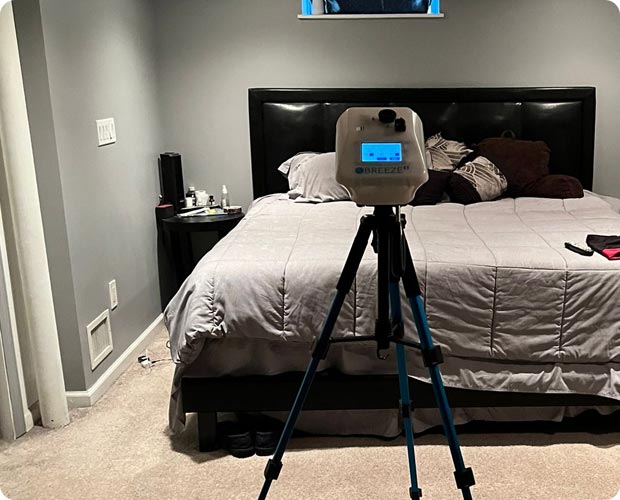
Air sampling for mold uses impaction cassettes (Air-O-Cell, Zefon BioPump) that capture particles from a calibrated air volume onto a collection medium. The cassette is analysed by a qualified analyst under microscopy. Results are reported as spores per cubic metre for each species identified. Critically, indoor samples must always be compared to an outdoor control sample taken simultaneously — outdoor spore counts vary by season, weather, and location.