HVAC mold cleaning in Kensington: what to know
Kensington's Victorian bungalows and Craftsman homes from the 1900s–1930s are among the oldest residential stock in Montgomery County — original wood-lath plaster, cedar shingle roofs, and minimal attic insulation create a high-mold-risk profile in wet or humid conditions.
Many Kensington properties have root-damaged drain lines and aging cast-iron plumbing — slow underground leaks can saturate basement framing over months before discovery, producing extensive Stachybotrys growth behind finished surfaces.
Mold conditions in Kensington
Common mold types in this area: Penicillium (plaster walls with historic moisture infiltration); Cladosporium (wood exterior trim and cedar shingle substrate); Stachybotrys (basement framing from root-damaged drain lines); Chaetomium (water-damaged wood lath plaster).
We serve Kensington Town Hall, Noyes Library for Young Children, Kensington Antique Row (Howard Avenue), Rock Creek Trail (nearby) and the wider Kensington area across ZIP codes 20895.
Signs you need HVAC mold cleaning
- Musty odour from supply vents when the HVAC system is running
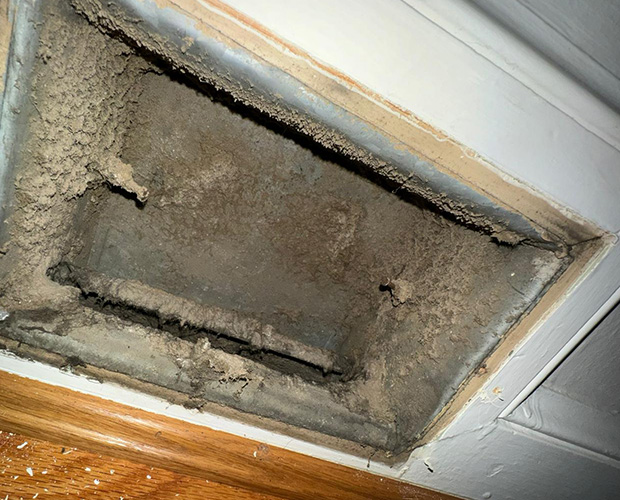
- Visible mold or dark staining inside the supply or return registers
- Elevated mold spore counts in rooms that do not have visible mold on walls or ceilings
- Allergy or respiratory symptoms that worsen when the HVAC is operating
- Visible mold on the evaporator coil or in the air handler cabinet
- Drain pan that is not draining (standing water in the condensate pan)
How we handle HVAC mold cleaning in Kensington
HVAC systems can harbour and distribute mold throughout an entire building. The air handler's evaporator coil and drain pan are the most common mold sites — condensate from the cooling process creates a continuously wet surface that supports Cladosporium, Penicillium, and in neglected systems, Stachybotrys. When the system runs, mold spores are drawn off these surfaces and distributed through the duct system to every room.
Routine duct cleaning (vacuuming the inside of ductwork) is not HVAC mold remediation. Duct cleaning removes accumulated dust and debris but does not address mold on the coil, drain pan, or inside the air handler itself. HVAC mold remediation requires treating the air handler as a mold-contaminated area, using EPA-registered antifungal agents on all interior surfaces, replacing the filter, and testing air quality after treatment with the system running.