Skip to content
Licensed mold remediation — call to schedule
ES
MoldAct logo MoldAct IICRC S520 Certified Mold Remediation
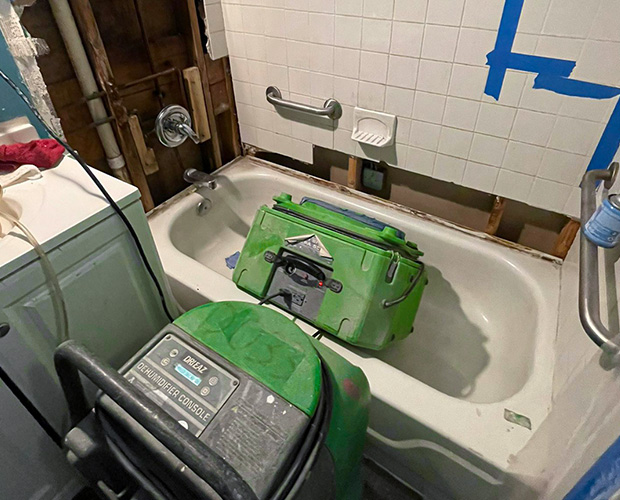
Mold growth along bathroom tile and grout caused by excess moisture and poor ventilation

Bathroom Mold Removal in Potomac, MD

Bathroom mold may be surface growth (Cladosporium on grout or caulk, treatable with professional cleaning) or structural (mold behind drywall or subfloor from chronic moisture), which requires IICRC S520 protocol remediation — a professional assessment determines which applies.

Get Your Free Mold Inspection

Or call now: (877) 660-0430

Bathroom mold removal in Potomac: what to know

Potomac's high-value single-family homes — many on heavily wooded 1–5 acre lots — face constant organic debris accumulation on roofs and in gutters. Leaf and branch debris traps moisture on roofing substrates, accelerating shingle degradation and creating attic mold entry points that go undetected for years.

Large Potomac properties frequently have pool houses, guest suites over garages, and finished basement home offices — each a separate potential mold location requiring independent inspection. Deferred maintenance on accessory structures is a common mold source.

The combination of clay soil (poor drainage), heavy tree canopy (high ambient humidity under the canopy), and older home construction (1970s–1990s) creates a high-mold-risk environment where inspection at time of purchase and after any water event is essential.

Mold conditions in Potomac

Common mold types in this area: Cladosporium (attic — dominant in roof-deck and rafter mold from gutter overflow); Stachybotrys (attic framing from chronic slow roof leaks in older Potomac estates); Aspergillus/Penicillium (pool house and accessory building humidity); Chaetomium (water-damaged drywall in basements and lower-level home offices).

We serve Potomac Village, C&O Canal National Historical Park, Cabin John Regional Park, The Potomac School (nearby), Avenel Golf Course and the wider Potomac area across ZIP codes 20854.

Signs you need bathroom mold removal

  • Black or greenish mould visible on grout lines, caulk, or tile surfaces
  • Soft or spongy drywall at the base of the shower or bath surround
  • Bubbling, cracked, or loose tiles — often indicating moisture migration behind
  • Persistent musty odour in the bathroom after surface cleaning
  • Staining on the ceiling below a bathroom (mold in subfloor or hidden leak)
  • Visible mold at the base of toilet, vanity, or around plumbing penetrations

How we handle bathroom mold removal in Potomac

Bathroom mold is extremely common and ranges from minor surface growth on grout and caulk to serious structural mold growth behind tile, in wall cavities, and under subfloor decking. The difference matters enormously: surface mold on a non-porous substrate (glazed tile, sealed grout) can often be professionally cleaned without demolition; mold inside the wall cavity requires opening the wall, removing affected drywall and insulation, and following IICRC S520 protocol.

The most common bathroom moisture sources are: inadequate or non-functioning exhaust ventilation, grout and caulk failures that allow water into wall cavities, overflow from showers or tubs, and chronic toilet base leaks. In all cases, the moisture source must be corrected before any mold treatment — retiling over wet, contaminated drywall simply delays the problem.

Simple, transparent process

Our Potomac Bathroom Mold Removal Process

  1. 1

    Surface vs. structural assessment

    The assessor uses a moisture meter and, if needed, thermal imaging to determine whether moisture has penetrated behind the tile surface. Probe holes or exploratory opening may be specified to confirm the extent.

  2. 2

    Surface mold treatment (if applicable)

    Surface mold on non-porous tile and sealed grout is treated with EPA-registered antifungal agents, HEPA-vacuumed, and recaulked. This is not a remediation — it is maintenance cleaning appropriate only when the tile assembly is confirmed intact and the moisture source is controlled.

  3. 3

    Structural remediation (if required)

    Affected tile and drywall are removed to expose the framing. Mold on studs and blocking is treated per the IICRC S520 protocol. Subfloor damage is assessed and replaced if moisture-compromised. Containment is maintained to prevent spore spread to adjacent areas.

  4. 4

    Exhaust ventilation correction

    Bathroom exhaust fans are inspected and tested. Undersized or non-functioning fans are replaced with fans rated for the room volume (HVI-certified). Exhaust ducting is confirmed to terminate outside the building envelope.

  5. 5

    Reconstruction and clearance

    After clearance testing, the bathroom is rebuilt with cement board or moisture-resistant substrate, waterproofing membrane at wet areas, and properly sealed tile installation. A clearance report documents that the remediation met IICRC standards.

Bathroom Mold Removal in Potomac — FAQs

Do you provide bathroom mold removal in Potomac?

Yes — MoldAct provides bathroom mold removal throughout Potomac, MD (ZIP codes: 20854) and surrounding Montgomery County areas. Call us to book the earliest available appointment.

Can I remove bathroom mold with bleach?

Bleach kills surface mold on non-porous surfaces only. It does not penetrate grout or caulk effectively, does not treat mold on porous materials like drywall, and does not remove the dead mold or its allergens. For structural mold, bleach is not appropriate and may produce harmful fumes in a confined space.

How do I prevent mold from coming back in my bathroom?

Run the exhaust fan for at least 20–30 minutes after every shower, maintain grout and caulk sealing annually, wipe down shower surfaces after use, and maintain relative humidity below 60% with air conditioning or dehumidification. Condensation on cold surfaces is a key warning sign of inadequate ventilation.

Bathroom Mold Removal in Potomac — book today

Licensed, insured mold remediation contractors. Call to schedule.

Call Now Free Quote