Mold testing is not the same as a mold inspection. Testing refers specifically to the collection and laboratory analysis of air or surface samples to identify mold species and quantify spore concentrations. An inspection includes testing but also includes a visual survey, moisture mapping, and a written remediation protocol. Testing alone — without the inspection context — can produce data that is difficult to interpret correctly.
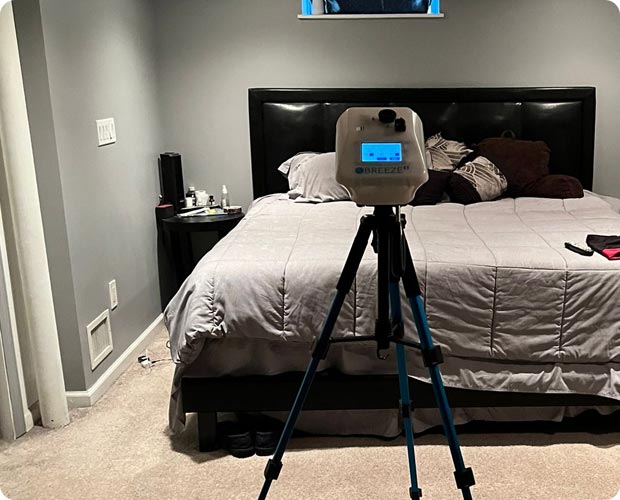
Air sampling for mold uses impaction cassettes (Air-O-Cell, Zefon BioPump) that capture particles from a calibrated air volume onto a collection medium. The cassette is analysed by a qualified analyst under microscopy. Results are reported as spores per cubic metre for each species identified. Critically, indoor samples must always be compared to an outdoor control sample taken simultaneously — outdoor spore counts vary by season, weather, and location.
Surface sampling (tape-lift, swab, or bulk) identifies what species are present at a specific location. This is especially important for Stachybotrys, which has heavy, sticky spores that may not appear in air samples even when a large colony is present. An AIHA-accredited laboratory provides the most reliable and defensible results.
Señales de que necesita prueba de moho
- Unexplained musty odour with no visible mold
- Health symptoms that improve when occupants leave the building
- Post-remediation verification that work was completed successfully
- Pre-purchase due diligence on a home or commercial property
- Landlord-tenant dispute requiring independent third-party documentation
- Insurance claim requiring laboratory evidence of mold type and extent
Por qué Miami lo sufre
Baltimore: Cladosporium and Aspergillus/Penicillium are the dominant outdoor species — elevated indoor counts of these species relative to outdoor must be interpreted in seasonal context. Stachybotrys in Baltimore properties is almost always associated with chronic basement seepage.
New Jersey: elevated Chaetomium in NJ properties typically indicates water-damaged cellulose (paper-faced drywall or wallpaper) — it is less common than Stachybotrys but equally problematic in terms of remediation requirements.
Miami: outdoor spore counts in South Florida are among the highest in the continental US year-round. Professional interpretation is essential — without comparing to an outdoor control, indoor results in Miami can appear alarming when they actually reflect outdoor background levels.