HVAC mold cleaning in McKinney: what to know
McKinney is one of the fastest-growing Dallas-Fort Worth suburbs, with housing stock ranging from 1990s subdivisions to new-build developments — newer construction still commonly shows HVAC condensate and window-flashing mold issues from builder-grade installation.
North Texas' expansive clay soil shrinks and swells with moisture changes, a common cause of foundation cracks that let groundwater migrate into slab-on-grade homes and drive mold behind baseboards and drywall.
McKinney's hot, humid subtropical summers push air conditioning systems hard for months at a time — oversized or poorly maintained AC units can under-dehumidify a home even while cooling it, a frequently overlooked mold driver.
Mold conditions in McKinney
Common mold types in this area: Aspergillus/Penicillium (HVAC systems and slab-leak moisture migration); Cladosporium (exterior surfaces and ambient outdoor background); Stachybotrys chartarum (chronic under-slab or foundation-crack moisture); Chaetomium (water-damaged drywall from slab leaks).
We serve Historic Downtown McKinney Square, Towne Lake Recreation Area, Erwin Park, The Grand at Craig Ranch, McKinney Performing Arts Center and the wider McKinney area across ZIP codes 75069, 75070, 75071, 75072.
Signs you need HVAC mold cleaning
- Musty odour from supply vents when the HVAC system is running
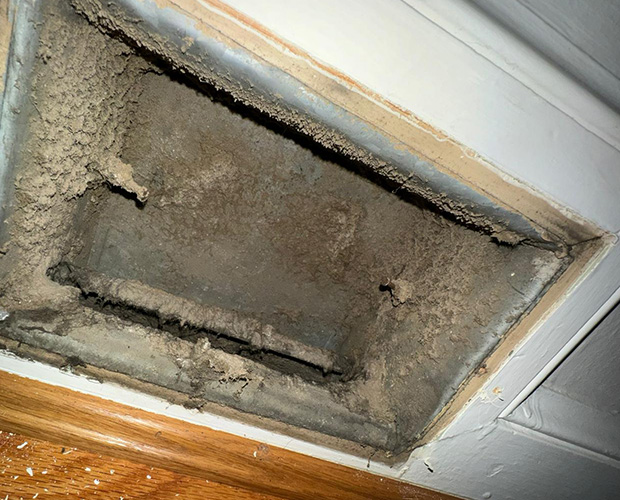
- Visible mold or dark staining inside the supply or return registers
- Elevated mold spore counts in rooms that do not have visible mold on walls or ceilings
- Allergy or respiratory symptoms that worsen when the HVAC is operating
- Visible mold on the evaporator coil or in the air handler cabinet
- Drain pan that is not draining (standing water in the condensate pan)
How we handle HVAC mold cleaning in McKinney
HVAC systems can harbour and distribute mold throughout an entire building. The air handler's evaporator coil and drain pan are the most common mold sites — condensate from the cooling process creates a continuously wet surface that supports Cladosporium, Penicillium, and in neglected systems, Stachybotrys. When the system runs, mold spores are drawn off these surfaces and distributed through the duct system to every room.
Routine duct cleaning (vacuuming the inside of ductwork) is not HVAC mold remediation. Duct cleaning removes accumulated dust and debris but does not address mold on the coil, drain pan, or inside the air handler itself. HVAC mold remediation requires treating the air handler as a mold-contaminated area, using EPA-registered antifungal agents on all interior surfaces, replacing the filter, and testing air quality after treatment with the system running.