HVAC mold cleaning in Hialeah: what to know
Hialeah is the largest predominantly Spanish-speaking city in the US — MoldAct's bilingual service capability is essential for this market where language barriers have historically delayed mold detection and remediation.
The city has a mix of 1950s–1980s CBS construction and 1990s–2000s residential subdivisions — the older stock has higher rates of HVAC condensate overflow mold, while newer properties show mold from inadequate attic ventilation in the tropical heat.
Proximity to Miami Canal and the western Everglades gives Hialeah very high ambient humidity and a relatively high water table in the western sections.
Mold conditions in Hialeah
Common mold types in this area: Aspergillus/Penicillium (dominant in tropical humidity); Cladosporium (outdoor air is among the highest spore counts in the US); Stachybotrys (HVAC-saturated wall cavities).
We serve Hialeah Park Racing and Casino, Miami Lakes (nearby), Amelia Earhart Park, Palm Springs Mile shopping district and the wider Hialeah area across ZIP codes 33010, 33012, 33013, 33014, 33016.
Signs you need HVAC mold cleaning
- Musty odour from supply vents when the HVAC system is running
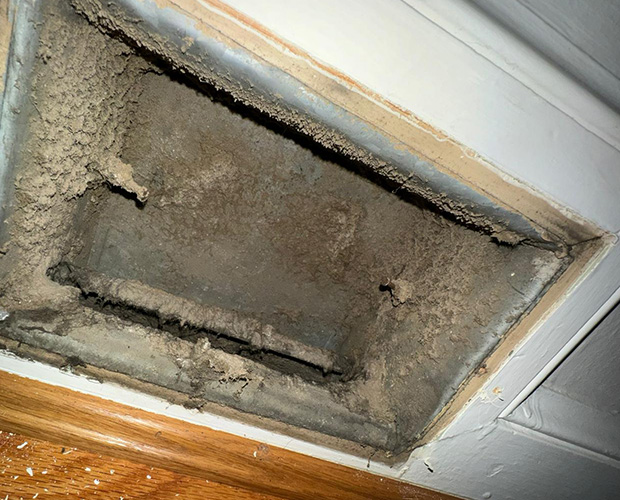
- Visible mold or dark staining inside the supply or return registers
- Elevated mold spore counts in rooms that do not have visible mold on walls or ceilings
- Allergy or respiratory symptoms that worsen when the HVAC is operating
- Visible mold on the evaporator coil or in the air handler cabinet
- Drain pan that is not draining (standing water in the condensate pan)
How we handle HVAC mold cleaning in Hialeah
HVAC systems can harbour and distribute mold throughout an entire building. The air handler's evaporator coil and drain pan are the most common mold sites — condensate from the cooling process creates a continuously wet surface that supports Cladosporium, Penicillium, and in neglected systems, Stachybotrys. When the system runs, mold spores are drawn off these surfaces and distributed through the duct system to every room.
Routine duct cleaning (vacuuming the inside of ductwork) is not HVAC mold remediation. Duct cleaning removes accumulated dust and debris but does not address mold on the coil, drain pan, or inside the air handler itself. HVAC mold remediation requires treating the air handler as a mold-contaminated area, using EPA-registered antifungal agents on all interior surfaces, replacing the filter, and testing air quality after treatment with the system running.