HVAC mold cleaning in Baltimore: what to know
Baltimore has one of the oldest housing stocks in the mid-Atlantic region — the city's signature brick rowhouses, most built between 1870 and 1940, have unreinforced brick foundations with no waterproofing membrane, making basement seepage and mold virtually universal in older stock.
Baltimore's humid subtropical climate produces long, wet summers with relative humidity regularly above 70% from June through September, creating ideal conditions for mold growth on any moisture-compromised building material.
The city's aging water infrastructure means pipe failures and sewer backups are more frequent than in newer municipalities — Category 2 and Category 3 water events often precede mold discovery in basement and lower-floor units.
Mold conditions in Baltimore
Common mold types in this area: Cladosporium (dominant outdoor species, elevated indoors from basement moisture); Penicillium/Aspergillus (common in damp basements and behind failed wallpaper); Stachybotrys chartarum (basement framing with chronic seepage); Chaetomium (water-damaged drywall and cellulose materials).
We serve Inner Harbor, Fort McHenry, Johns Hopkins Hospital, Maryland Science Center, Baltimore Convention Center and the wider Baltimore area across ZIP codes 21201, 21202, 21205, 21206, 21211, 21213, 21217, 21218, 21223.
Signs you need HVAC mold cleaning
- Musty odour from supply vents when the HVAC system is running
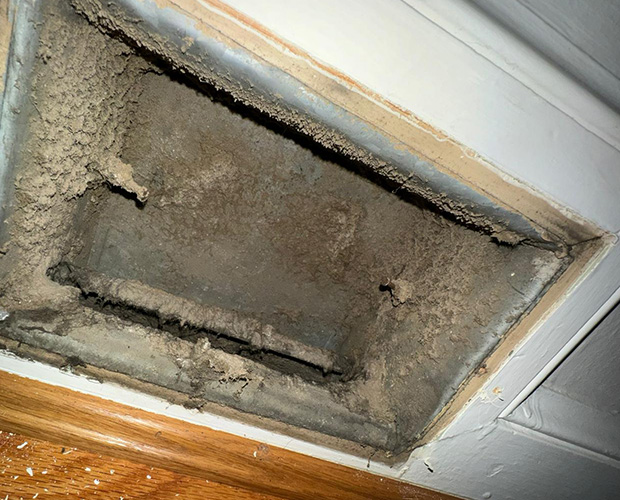
- Visible mold or dark staining inside the supply or return registers
- Elevated mold spore counts in rooms that do not have visible mold on walls or ceilings
- Allergy or respiratory symptoms that worsen when the HVAC is operating
- Visible mold on the evaporator coil or in the air handler cabinet
- Drain pan that is not draining (standing water in the condensate pan)
How we handle HVAC mold cleaning in Baltimore
HVAC systems can harbour and distribute mold throughout an entire building. The air handler's evaporator coil and drain pan are the most common mold sites — condensate from the cooling process creates a continuously wet surface that supports Cladosporium, Penicillium, and in neglected systems, Stachybotrys. When the system runs, mold spores are drawn off these surfaces and distributed through the duct system to every room.
Routine duct cleaning (vacuuming the inside of ductwork) is not HVAC mold remediation. Duct cleaning removes accumulated dust and debris but does not address mold on the coil, drain pan, or inside the air handler itself. HVAC mold remediation requires treating the air handler as a mold-contaminated area, using EPA-registered antifungal agents on all interior surfaces, replacing the filter, and testing air quality after treatment with the system running.