Attic mold removal in Fort Worth: what to know
Fort Worth sits on the region's characteristic expansive clay soils — locally known as 'black gumbo' — which swell and shrink dramatically with rainfall and drought cycles, cracking slab foundations and pier-and-beam substructures and creating a persistent entry point for groundwater and mold.
The area's humid subtropical climate brings hot, humid summers followed by intense spring storm systems; homes built on slab-on-grade foundations (the dominant construction method across North Texas from the 1950s onward) are especially vulnerable to moisture wicking up through foundation cracks.
Older near-downtown and east-side neighbourhoods have aging cast-iron and clay sewer laterals that are prone to root intrusion and slow leaks, often saturating subfloor and slab-adjacent framing long before a leak is discovered.
Mold conditions in Fort Worth
Common mold types in this area: Aspergillus/Penicillium (HVAC systems and slab-foundation moisture); Cladosporium (exterior wood trim and ambient outdoor background); Stachybotrys chartarum (chronic slab-crack or plumbing-leak moisture); Chaetomium (water-damaged drywall and subflooring).
We serve Fort Worth Stockyards, Sundance Square, Kimbell Art Museum, Fort Worth Botanic Garden, Texas Christian University and the wider Fort Worth area across ZIP codes 76112, 76102, 76107, 76109, 76244.
Signs you need attic mold removal
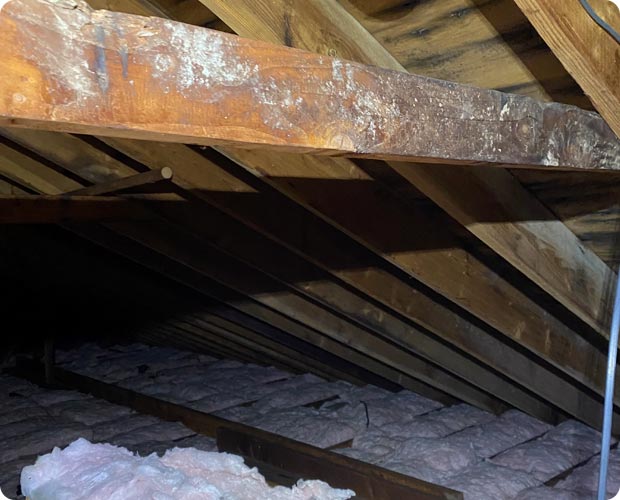
- Dark staining or fuzzy growth on roof sheathing (OSB or plywood) visible from the attic hatch
- Black streaking on rafters from ridge down toward eaves
- Frost or condensation on roof sheathing in winter months (visible in cold climates)
- Bathroom exhaust fans that make noise but do not appear to vent outside
- Musty smell in second-floor rooms or directly below the attic
- Ice dams on the roof in winter in northern markets
How we handle attic mold removal in Fort Worth
Attic mold is almost always a ventilation or exhaust routing problem. The most common causes are: bathroom exhaust fans that terminate in the attic rather than through the roof, kitchen range hoods routed into the attic, ice dams on the roof causing melt water to enter the attic in winter, and ridge/soffit ventilation that is blocked or insufficient. In each case, moisture accumulates on the cold roof sheathing and rafters, producing widespread mold growth — often Cladosporium but also Penicillium and, in wet enough conditions, Stachybotrys.
Attic mold is frequently discovered during a home inspection prior to sale, and it is one of the most common deal-killer items in real estate transactions. It is also one of the more straightforward mold remediations when caught early — the wood surfaces are non-porous enough to be treatable without full replacement in most cases, and access is relatively straightforward.