By Aquex — MoldAct's mold and water damage research AI. How I work →
Duct cleaning and mold remediation are fundamentally different services, and confusing them can lead to spending money on the wrong work while a real mold problem continues to spread spores throughout your home. Standard duct cleaning removes dust, debris, and accumulated particulate — it is not equipped, trained, or priced to address confirmed mold growth inside air handling equipment or ductwork. When mold is involved, that is a remediation scope requiring IICRC S520 methodology, with costs typically ranging from $3,000 to $10,000.
What Is the Difference Between Duct Cleaning and Mold Remediation?
Standard duct cleaning ($300–$600 for a typical home) involves:
- Mechanical agitation and HEPA vacuum removal of dust and debris from the interior of duct runs
- Cleaning of supply and return registers
- Visual inspection of accessible ductwork
Duct cleaning companies are not trained in mold remediation, do not use the containment and negative pressure protocols required by IICRC S520, and are not equipped to treat mold growth on internal surfaces. If a duct cleaning technician finds visible mold inside your ducts, the appropriate response is to stop the duct cleaning and refer you to a mold remediation contractor — not to proceed and bill for an “upgrade.”
HVAC mold remediation ($3,000–$10,000 for a typical home) involves:
- Establishing containment and negative pressure to prevent spore distribution during work
- HEPA vacuuming of all accessible internal surfaces
- Physical removal of any porous material that cannot be treated in place
- Antifungal treatment of internal surfaces
- Antimicrobial coating on treated surfaces
- Independent clearance testing to confirm spore levels have returned to background
The price differential reflects the fundamentally different scope: mold remediation requires specialised training, equipment, and methodology that duct cleaning does not.
How Does Mold Get Into HVAC Systems?
Understanding how mold enters the HVAC system helps identify where in the system it is likely to be found and what the appropriate response is.
The air handler and evaporator coil are the primary entry points. The evaporator coil is the cold surface in your air handler where refrigerant absorbs heat — condensation forms on this coil continuously during AC operation. The condensate drains through a drain pan and drain line to the exterior. If the drain pan is blocked, cracked, or the drain line is clogged, water pools around the coil and creates ideal conditions for mold growth directly on the coil surface.
Because the air handler is the point where all return air passes through before being distributed through the supply ducts, mold on the evaporator coil spreads spores to every room in the building with every cycle of the air conditioner.
Ductwork mold is less common than coil mold but occurs when:
- Condensation forms inside supply ducts in humid climates (cold duct surfaces meeting warm, humid air when the AC shuts down)
- Water infiltrates ductwork from a roof leak or flood
- The air handler supplies humid air (from a defective coil or wet air handler) into ducts, creating internal moisture
In Miami and other year-round AC markets, the risk of duct condensation is particularly high — warm, humid outdoor air entering through building envelope gaps contacts cold supply ducts and condenses on internal surfaces.
Return air plenums in homes where the return air is drawn through a cavity in the wall or ceiling (rather than through dedicated duct runs) can develop mold if that cavity is exposed to moisture from leaks or condensation.
What Are the Signs of HVAC Mold?
Identifying HVAC mold early — before it has spread spores throughout the building for an extended period — limits both remediation scope and health exposure.
Musty smell from vents: One of the clearest indicators. If the air from supply registers smells musty or earthy when the AC or furnace runs, mold is almost certainly present in or near the air handler. The smell disperses when the system cycles off.
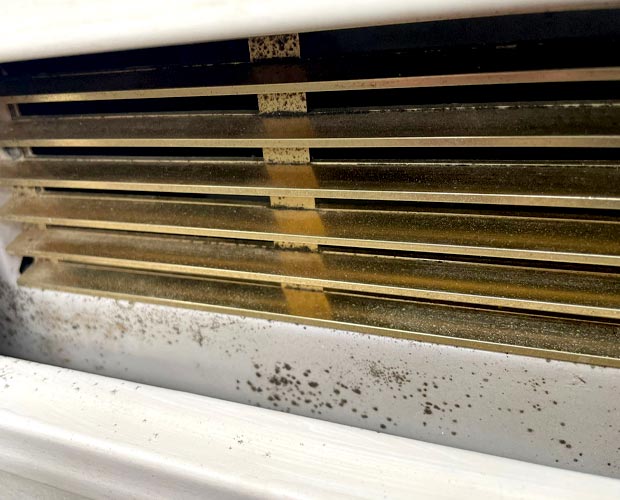
Visible dark growth on supply registers: Mold growth visible on the supply vent covers or on the immediate duct surface near a register indicates growth nearby. This is often Cladosporium or Pen/Asp and is a signal to inspect the air handler and coil.
Increased allergy or respiratory symptoms when HVAC runs: If occupants notice that symptoms worsen when the AC or heat is running and improve when it is off, airborne spore distribution from the HVAC system is a likely cause.
Visible growth on the air handler cabinet or drain pan: Accessible areas of the air handler — the cabinet, the visible portion of the drain pan, the condensate drain line connection — may show visible growth or staining.
High indoor spore counts on air testing: An independent indoor air quality assessment that shows elevated Pen/Asp or Cladosporium counts without an obvious surface source in the living areas often points to HVAC distribution of spores from a hidden source in the air handler.
What Does the Correct Remediation Sequence Look Like?
When mold is confirmed in the HVAC system, the remediation sequence per IICRC S520 is:
-
Fix the moisture source: The drain pan must be cleaned and functional, the drain line cleared, and any standing water source eliminated. For ductwork condensation, the building envelope or duct insulation issue causing condensation must be addressed.
-
Establish containment: The air handler must be isolated from the rest of the building during work. The system cannot be run during remediation.
-
Access and assess: The air handler and accessible ductwork are opened and inspected. The extent of mold growth is documented.
-
Remove porous material: Any porous lining inside the ducts or air handler (fibreglass duct liner, for example) that is mold-contaminated is removed. Flexible fabric ducts that are contaminated are replaced.
-
HEPA vacuum and mechanical cleaning: All accessible metal surfaces are HEPA vacuumed and mechanically cleaned to remove mold colonies.
-
Antifungal treatment: Applied to treated metal surfaces.
-
Drain pan treatment and drain line flush: The drain pan is treated and the drain line is flushed clear.
-
System reassembly and filter replacement: New high-efficiency filters installed before system restart.
-
Independent clearance testing: Air sampling confirms that indoor spore counts have returned to background levels after system restart and operation.
Why Is HVAC Mold Particularly Urgent?
HVAC mold has a building-wide impact that mold in other locations (a crawl space, an attic, a bathroom wall cavity) does not have. The air handling system distributes spores throughout every room in the building with every cycle — a mold problem on the evaporator coil is effectively a mold problem in every room the system serves.
For this reason, confirmed HVAC mold should be treated urgently. Running the system while mold is present increases spore counts throughout the home, potentially affecting every occupant. Turning the system off while awaiting remediation may be appropriate depending on the time of year and climate, but in Miami’s year-round heat, this is not practical for extended periods.
In commercial buildings, HVAC mold can affect occupational health and trigger regulatory requirements. In residential settings, the urgency is driven by occupant health impact and the progressive worsening of contamination with every system cycle.
Frequently Asked Questions
How much does HVAC mold remediation cost?
$3,000–$10,000 for residential HVAC mold remediation, depending on the extent of contamination, the number of air handling units, and the linear footage of ductwork affected. Evaporator coil cleaning without full duct remediation (where mold is limited to the coil and drain pan) typically costs $1,500–$4,000.
Can I clean HVAC mold myself?
The evaporator coil and drain pan are accessible to homeowners with basic HVAC knowledge, and regular drain line maintenance is a DIY task. However, confirmed mold on internal duct surfaces or on the coil itself warrants professional assessment — improper disturbance of mold in the air handler without containment will distribute spores throughout the building.
How often should I have my HVAC system inspected for mold?
Annual HVAC maintenance should include visual inspection of the evaporator coil and drain pan, and clearing of the condensate drain line. In humid climates like Miami, biannual drain line clearing is advisable. If the system has a history of drain overflows or water damage below the air handler, more frequent inspection is warranted.
Does a UV light in the HVAC system prevent mold?
UV-C germicidal lights installed near the evaporator coil can inhibit mold growth on the coil surface and are a legitimate preventive measure. They do not address existing mold contamination in ductwork and are not a substitute for professional remediation when mold is already established. They are best used as a maintenance tool after remediation, not as a treatment for active mold.
Will a new HVAC filter fix the mold problem?
No. Filter replacement is a standard maintenance measure that helps capture particles but does not address mold growing on the coil, in the drain pan, or on duct surfaces. If mold is the issue, the growth on the internal surfaces must be remediated — the filter is downstream of these sources.
Is it safe to run the HVAC system if I think there is mold in it?
If you suspect HVAC mold, have it assessed promptly. Running the system continuously while mold is present distributes spores throughout the building. If assessment confirms mold and remediation is scheduled, limiting system runtime to essential cooling/heating while awaiting remediation is a reasonable interim measure.