Mold inspection in Plano: what to know
Plano's housing stock is dominated by 1970s–2000s master-planned suburban construction on slab-on-grade foundations — the same Blackland Prairie clay soils that affect the broader Dallas-Fort Worth metro cause foundation movement that cracks slabs and lets moisture migrate into subfloor and wall-base assemblies.
North Texas's hot, humid summers combined with intense spring rain events put steady pressure on roofing and HVAC systems in Plano's aging first-generation subdivisions, where original ductwork and drain pans are increasingly prone to condensate failures.
Many Plano homes have finished basements or below-grade utility rooms far less often than the mid-Atlantic and Northeast markets, but slab-plumbing leaks under the foundation are a distinctly Texas mold driver — water travels laterally under the slab and can surface mold at baseboards well away from the original leak.
Mold conditions in Plano
Common mold types in this area: Aspergillus/Penicillium (HVAC systems and slab-leak moisture migration); Cladosporium (exterior surfaces and ambient outdoor background); Stachybotrys chartarum (chronic under-slab or foundation-crack moisture); Chaetomium (water-damaged drywall from slab leaks).
We serve Legacy West, The Shops at Willow Bend, Arbor Hills Nature Preserve, Haggard Park, Historic Downtown Plano and the wider Plano area across ZIP codes 75093, 75023, 75024, 75025, 75074.
Signs you need mold inspection
- Visible dark or discoloured patches on walls, ceilings, or floors
- Persistent musty or earthy odour in one or more rooms
- Unexplained respiratory symptoms or allergic reactions indoors
- Water stains, efflorescence, or swollen drywall
- Recent water intrusion — roof leak, burst pipe, or flooding
- Condensation on windows or cold surfaces in humid conditions
- Peeling paint or wallpaper that is not explained by age
How we handle mold inspection in Plano
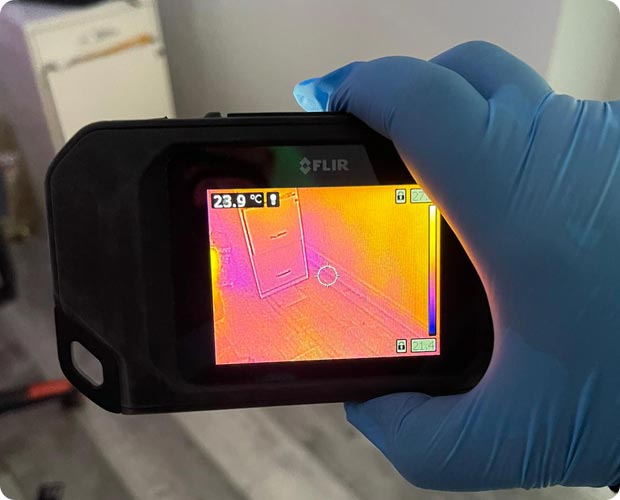
A mold inspection is the essential first step before any remediation work. A licensed mold assessor conducts a systematic visual survey of the property, uses moisture meters and thermal imaging to locate hidden wet areas, and collects air or surface samples where mold is suspected or confirmed. Samples are sent to an accredited AIHA laboratory for species identification and spore-count analysis.
Under the NYS 2015 Mold Law and analogous Florida and New Jersey regulations, the mold assessor and the mold remediator must be separate companies. This independence protects homeowners from inflated scopes and conflicts of interest. MoldAct works exclusively with licensed, independent assessors in each market.