Black mold removal in Newark: what to know
Newark has one of the oldest urban housing stocks in New Jersey — many three-family and four-family Victorian houses from the 1880s–1920s have unreinforced masonry foundations and original plumbing that make basement mold endemic.
The city's low-lying topography and proximity to the Passaic River and Newark Bay make flooding and groundwater infiltration common during significant rain events — many properties in the Ironbound and Vailsburg sections experience seasonal basement flooding.
Hurricane Sandy (2012) severely affected Newark's waterfront and industrial areas — properties that were not professionally remediated after Sandy have documented elevated mold risk in structural framing.
Mold conditions in Newark
Common mold types in this area: Cladosporium (exterior wood and masonry, basement); Stachybotrys (post-flood framing); Aspergillus/Penicillium (multi-family basement laundry and storage areas); Chaetomium (water-damaged drywall in multi-family buildings).
We serve Newark Liberty International Airport, Prudential Center, Newark Museum of Art, Branch Brook Park, Military Park and the wider Newark area across ZIP codes 07102, 07103, 07104, 07105, 07106, 07107, 07108.
Signs you need black mold removal
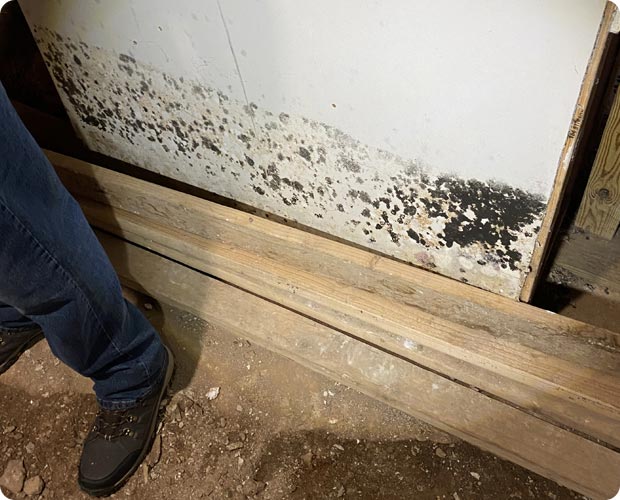
- Dark green, black, or greenish-black colonies on drywall, wood, or ceiling tiles
- Mold with a slimy or wet-looking surface texture (unlike dry, powdery Cladosporium)
- Musty or damp earthy odour in a basement, bathroom, or behind walls
- Mold growth in areas with a history of prolonged water exposure or chronic leaks
- Laboratory results identifying Stachybotrys on air or surface samples
- Health symptoms improving when leaving the property and returning when inside
How we handle black mold removal in Newark
Stachybotrys chartarum — commonly called black mold — is a dark-green to black mold species that grows on cellulose-rich materials (drywall paper, wood, ceiling tiles) that have been wet for an extended period, typically more than 48–72 hours. It is one of the species most associated with toxic mold exposure, though any mold at elevated indoor concentrations poses a health risk.
Because Stachybotrys spores are heavy and sticky, they do not disperse as readily as Cladosporium or Penicillium — which means air sampling alone may miss an active Stachybotrys colony. A licensed mold assessor will collect surface samples (tape-lift or swab) from any dark, slimy, or visually distinctive mold growth and send them to an AIHA laboratory for species confirmation.