Skip to content
Licensed mold remediation — call to schedule
ES
MoldAct logo MoldAct IICRC S520 Certified Mold Remediation
Crew in hazmat suits sanitizing a surface affected by black mold growth

Black Mold Removal in Edison, NJ

Black mold (Stachybotrys chartarum) removal requires a full IICRC S520 Level III protocol — independent assessment, negative-pressure containment, physical removal of all contaminated porous materials, P100 respirator protection, and independent clearance testing. Bleach or encapsulant spray is not remediation.

Get Your Free Mold Inspection

Or call now: (877) 660-0430

Black mold removal in Edison: what to know

Edison's post-war subdivision housing (1950s–1970s Cape Cods and split-levels) has crawl spaces with original 4-mil vapour barriers that have degraded over decades — crawl-space mold is extremely common in this housing vintage.

The Raritan River watershed portions of Edison have experienced repeated flooding during nor'easter storms — basement flooding and subsequent mold are recurring issues in low-lying sections.

Mold conditions in Edison

Common mold types in this area: Cladosporium (crawl space framing); Aspergillus/Penicillium (basement insulation and subfloor); Stachybotrys (chronic groundwater infiltration).

We serve Edison Memorial Tower, Menlo Park Mall, Roosevelt Park, Raritan Center Parkway and the wider Edison area across ZIP codes 08817, 08818, 08820, 08837.

Signs you need black mold removal

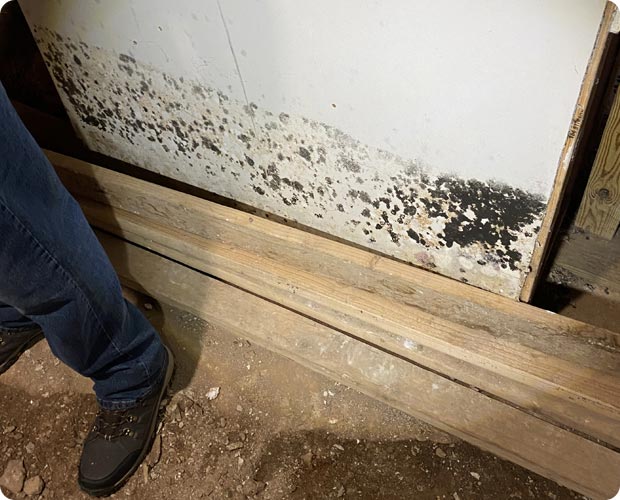
  • Dark green, black, or greenish-black colonies on drywall, wood, or ceiling tiles
  • Mold with a slimy or wet-looking surface texture (unlike dry, powdery Cladosporium)
  • Musty or damp earthy odour in a basement, bathroom, or behind walls
  • Mold growth in areas with a history of prolonged water exposure or chronic leaks
  • Laboratory results identifying Stachybotrys on air or surface samples
  • Health symptoms improving when leaving the property and returning when inside

How we handle black mold removal in Edison

Stachybotrys chartarum — commonly called black mold — is a dark-green to black mold species that grows on cellulose-rich materials (drywall paper, wood, ceiling tiles) that have been wet for an extended period, typically more than 48–72 hours. It is one of the species most associated with toxic mold exposure, though any mold at elevated indoor concentrations poses a health risk.

Because Stachybotrys spores are heavy and sticky, they do not disperse as readily as Cladosporium or Penicillium — which means air sampling alone may miss an active Stachybotrys colony. A licensed mold assessor will collect surface samples (tape-lift or swab) from any dark, slimy, or visually distinctive mold growth and send them to an AIHA laboratory for species confirmation.

Simple, transparent process

Our Edison Black Mold Removal Process

  1. 1

    Independent assessment and species confirmation

    A licensed mold assessor collects surface samples from the suspected area and submits them to an AIHA laboratory. Stachybotrys is confirmed by microscopic morphology. The assessor prepares a written protocol specifying Level III containment and removal scope.

  2. 2

    Level III containment

    The work area is sealed with 6-mil poly sheeting on all surfaces including the floor. A HEPA-filtered negative air machine operates continuously throughout the job, drawing contaminated air out through the HEPA filter. Workers wear full PPE: P100 half or full-face respirator, Tyvek suit, gloves, and boot covers.

  3. 3

    Physical removal of all contaminated porous materials

    All affected drywall, insulation, carpet, and other porous materials are removed and bagged inside the containment. No encapsulant is applied over Stachybotrys — the contaminated material must be physically removed.

  4. 4

    Structural surface treatment

    Exposed wood framing and masonry are HEPA-vacuumed, wire-brushed if needed, and treated with an EPA-registered antifungal. A barrier coating may be applied to clean, dry structural wood after treatment per the protocol.

  5. 5

    Independent clearance test

    Clearance samples are taken while containment is still in place. For Stachybotrys, surface samples from previously contaminated areas are included alongside air samples. Results must confirm the contaminated area is at normal (Condition 1) spore levels before containment is removed.

Black Mold Removal in Edison — FAQs

Do you provide black mold removal in Edison?

Yes — MoldAct provides black mold removal throughout Edison, NJ (ZIP codes: 08817, 08818, 08820, 08837) and surrounding New Jersey areas. Call us to book the earliest available appointment.

Is black mold dangerous?

All molds at elevated indoor levels can cause adverse health effects, particularly in sensitive individuals. Stachybotrys is associated with a range of symptoms including respiratory irritation, coughing, and in cases of prolonged heavy exposure, more serious health effects. If black mold is suspected, limit time in the affected area and schedule an inspection immediately.

Can I remove black mold myself?

Small areas (under 10 sq ft) of surface mold on non-porous materials may be cleaned with appropriate PPE. However, Stachybotrys on porous materials (drywall, wood) requires professional remediation. DIY attempts typically disturb the colony and aerosolise spores without adequately containing them, spreading contamination to adjacent areas.

How do I know if I have black mold?

Visual appearance is not sufficient — many molds are dark-coloured but not Stachybotrys, and not all Stachybotrys looks black. Laboratory identification from a surface sample by an AIHA-accredited lab is the only reliable confirmation.

Black Mold Removal in Edison — book today

Licensed, insured mold remediation contractors. Call to schedule.

Call Now Free Quote