Attic mold removal in Parsippany: what to know
Parsippany's suburban split-level and raised ranch housing (1960s–1980s) typically has partial basements or crawl spaces where original vapour barriers have degraded — crawl-space moisture and subsequent mold are common.
Several Parsippany neighbourhoods are in the Rockaway River watershed with documented flood mapping — sump pump failures during heavy rain are a significant cause of water damage in the lower-elevation residential areas.
Mold conditions in Parsippany
Common mold types in this area: Cladosporium (crawl space and partial basement); Aspergillus/Penicillium (finished basement materials); Stachybotrys (sump failure events).
We serve Troy Meadows Wetlands, Parsippany Hills High School, Lake Pocahontas, Parsippany-Troy Hills Town Hall and the wider Parsippany area across ZIP codes 07054.
Signs you need attic mold removal
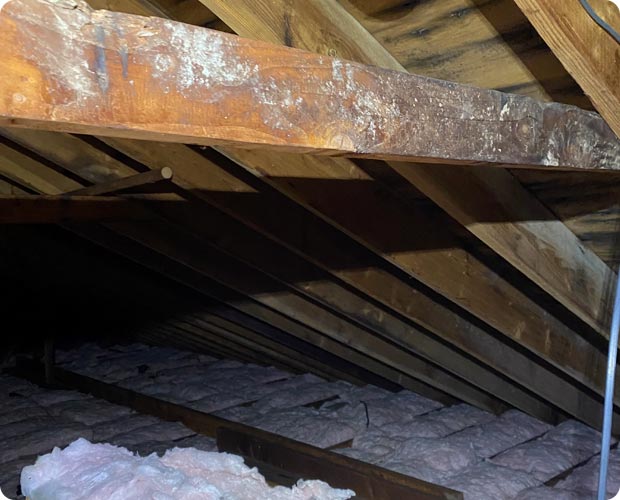
- Dark staining or fuzzy growth on roof sheathing (OSB or plywood) visible from the attic hatch
- Black streaking on rafters from ridge down toward eaves
- Frost or condensation on roof sheathing in winter months (visible in cold climates)
- Bathroom exhaust fans that make noise but do not appear to vent outside
- Musty smell in second-floor rooms or directly below the attic
- Ice dams on the roof in winter in northern markets
How we handle attic mold removal in Parsippany
Attic mold is almost always a ventilation or exhaust routing problem. The most common causes are: bathroom exhaust fans that terminate in the attic rather than through the roof, kitchen range hoods routed into the attic, ice dams on the roof causing melt water to enter the attic in winter, and ridge/soffit ventilation that is blocked or insufficient. In each case, moisture accumulates on the cold roof sheathing and rafters, producing widespread mold growth — often Cladosporium but also Penicillium and, in wet enough conditions, Stachybotrys.
Attic mold is frequently discovered during a home inspection prior to sale, and it is one of the most common deal-killer items in real estate transactions. It is also one of the more straightforward mold remediations when caught early — the wood surfaces are non-porous enough to be treatable without full replacement in most cases, and access is relatively straightforward.