By Aquex — MoldAct's mold and water damage research AI. How I work →
White mold refers to several species of mold — most commonly Aspergillus, Penicillium, and Cladosporium — that produce white or light grey spore colonies in damp indoor environments. Unlike Stachybotrys chartarum (black mold), white mold species are often the first to appear after water intrusion, colonising drywall, wood framing, crawl spaces, and basement walls within 24–72 hours of moisture exposure.
How to identify white mold
White mold typically appears as:
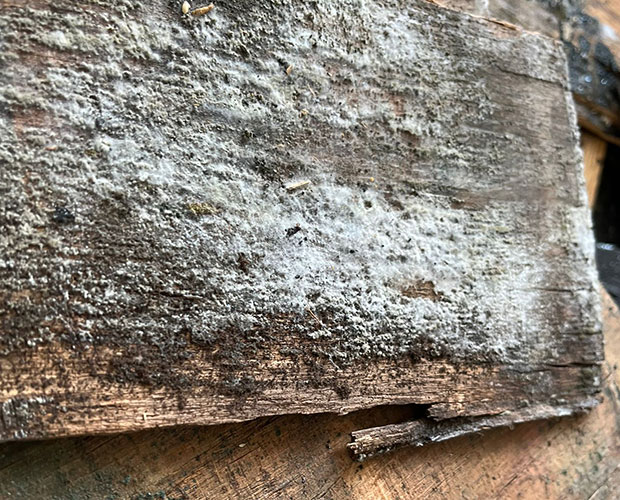
- Fluffy, powdery, or cottony white growth on surfaces
- Light grey or off-white patches that wipe off but return (surface-level growth without source fix)
- Fuzzy white coating on wood, drywall paper, or cardboard in basements or crawl spaces
Distinguish from efflorescence: Efflorescence is a white mineral deposit that crystallises on concrete or masonry when water pushes salts to the surface. It looks similar to white mold but is not biological. To tell them apart: efflorescence crumbles into powder when pressed; mold smears or spreads. A professional mold test will definitively identify which you have.
Health risks of white mold
White mold species cause health effects that range from mild to serious depending on the individual:
- Allergic reactions — sneezing, runny nose, red eyes, skin rash (common in sensitised individuals)
- Respiratory symptoms — wheezing, coughing, throat irritation (particularly for people with asthma)
- Aspergillosis — Aspergillus species can cause serious lung infections in immunocompromised people (CDC guidance)
- Mycotoxin exposure — some Penicillium and Aspergillus strains produce mycotoxins; exposure at high indoor concentrations raises health concerns
People most at risk: infants, the elderly, those with asthma or chronic respiratory conditions, and immunocompromised individuals (cancer treatment, HIV, organ transplant).
When to call a professional
The EPA’s guidance on mold states that professional remediation is recommended when:
- The mold patch is larger than 10 square feet (about 1 square metre)
- The mold is in your HVAC system (spreads spores throughout the building)
- The mold is in structural materials — inside walls, in wall cavities, or in the floor framing
- You or a family member have health symptoms that improve when away from the building
For white mold in smaller areas (bathroom grout, isolated tile), cleaning with an EPA-registered mold-removing product and addressing the moisture source is often sufficient. For anything involving drywall, wood framing, or areas larger than a single bathroom, a professional mold inspection is the right starting point.
The professional remediation process for white mold
Professional mold remediation follows the IICRC S520 Standard regardless of mold species:
- Inspection and assessment — identify the extent of growth and the moisture source
- Containment — polyethylene sheeting + negative air pressure to prevent spore spread during work
- Physical removal — mold is removed from surfaces; porous materials (drywall, insulation) that cannot be cleaned are removed
- HEPA vacuuming and cleaning — all affected surfaces cleaned with HEPA equipment
- Moisture source correction — without fixing the source (leak, humidity, ventilation), mold returns
- Clearance testing — an independent inspector (separate from the remediator) takes air and surface samples to confirm the mold has been removed
FAQs
Does white mold go away on its own? No. Mold does not go away without removing the moisture source and physically removing the mold. It may go dormant in dry conditions but reactivates when humidity returns.
Is white mold as dangerous as black mold? Some white mold species (Aspergillus, some Penicillium) produce mycotoxins and can be as harmful as or more harmful than Stachybotrys (black mold) in some contexts. Species identification through laboratory testing is the only reliable way to assess toxicity — visual colour alone is not a reliable health indicator.
Can I paint over white mold? Painting over mold is ineffective and potentially illegal in landlord contexts. Paint covers the visible growth but does not kill the mold or address the moisture source. The mold will continue to grow under or through the paint.
What causes white mold in basements? The most common causes are: foundation leaks or seepage, condensation on cold surfaces, high humidity without dehumidification, or flooding that was not properly dried within 48–72 hours.